Computational neuroscience and research systems
Computational neuroscience, EEG, human timing, and neurotechnology
My work is organized around connected research lines rather than a single method. The common thread is interpretable modelling, careful validation, reproducible analysis, developmental neuroimaging, and systems that keep scientific assumptions visible to the researcher.
The public portfolio shows enough methodological and conceptual context to make each research line understandable, while ongoing and unpublished work is deliberately described at a high level until it is ready for release.
Research ecosystem
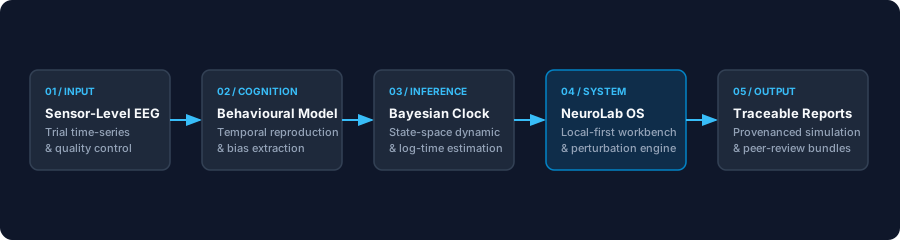
The research programme connects empirical signals and behaviour to explicit computational models, diagnostics, scientific software, and reproducible outputs rather than treating these as separate activities.
Active and established lines
Six connected research directions
EEG and neural time-series
Analysis of sensor-level neural signals, residual prediction, and brain-behaviour relationships in human timing and cognitive variability.
Temporal cognition and human time reproduction
Research on systematic bias in time reproduction, contextual effects, recent-trial influences, and computational accounts of temporal estimation.
Bayesian and state-space modelling
Interpretable behavioural models emphasizing central tendency, multiplicative variability, predictive diagnostics, and explicit model misspecification.
ABCD developmental neuroimaging
An ongoing research line using ABCD data to study adolescent brain maturation, resting-state connectivity, and dimensional autism/ADHD trait co-occurrence without disclosing unpublished analyses.
Neurotechnology and scientific systems
Design of privacy-aware and reproducible systems for neural analysis, modelling, simulation, multimodal inference, and research translation.
Evidence systems and scientific decision support
Structured evidence-review work focused on separating claims, sources, study design, outcome relevance, risk of bias, and support direction.


Public research boundaries
Public pages distinguish established preprints and manuscripts from active research lines. For projects such as ABCD developmental neuroimaging, the site communicates the scientific domain, datasets, and broad questions without exposing unpublished hypotheses, analyses, intermediate results, or collaborator-specific material.