Execution model
Local-first
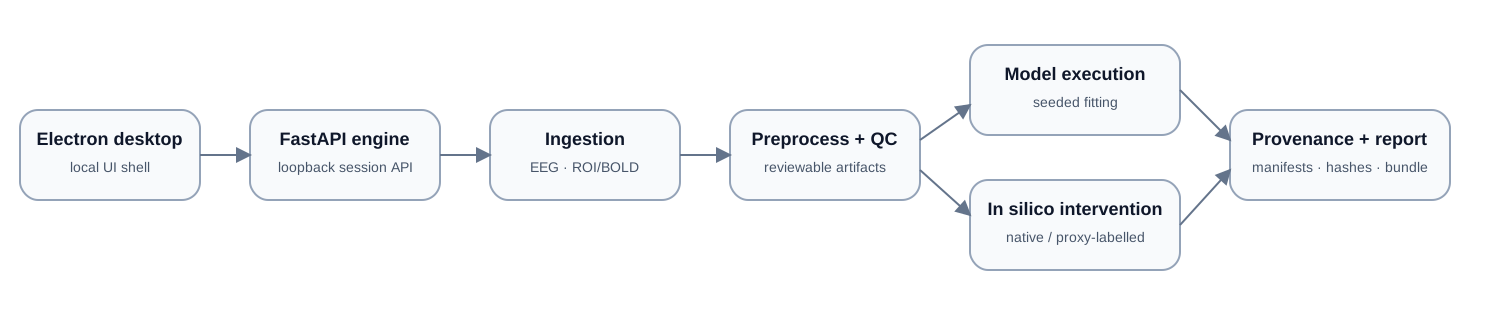
Electron/React desktop interface connected to a local Python/FastAPI scientific engine.
Scientific software workbench
NeuroLab OS is a local-first research-software environment for scientist-reviewed neural time-series modelling and provenance-aware simulation. The evaluated technical beta combines an Electron/React desktop interface with a local Python/FastAPI scientific engine.
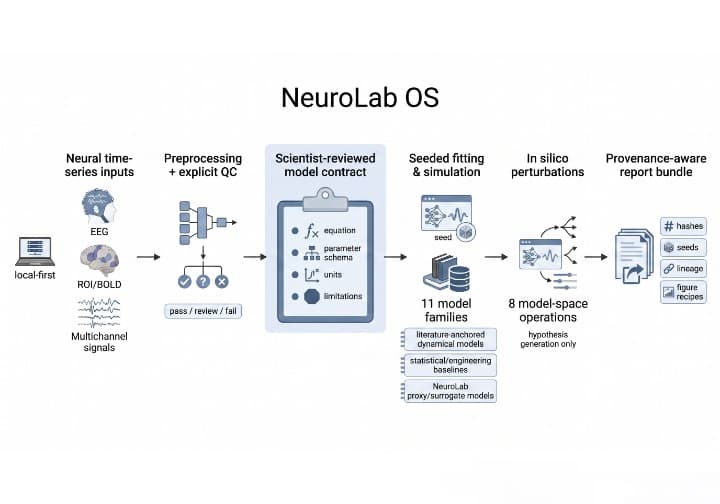
The workflow connects neural time-series ingestion, preprocessing, explicit quality-control review, scientist-visible model specifications, seeded model fitting, simulation, in silico perturbation, and provenance-aware reporting within one local execution path.
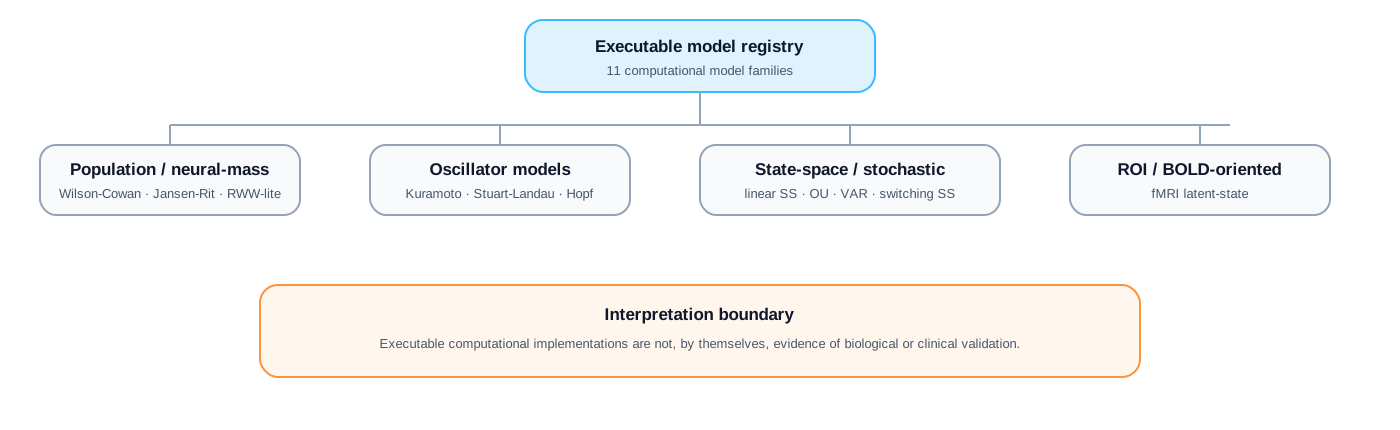
The evaluated runtime supports EEG-oriented and generic time-series ingestion together with ROI/BOLD matrix workflows. It contains 11 computational model families and eight explicitly in silico model-space perturbation operations.
NeuroLab OS is designed to preserve continuity between researcher-visible model semantics and executable computational provenance. Its scientific contribution is centered on traceability between model interpretation and execution rather than the introduction of a new neural equation.
Execution model
Local-first
Electron/React desktop interface connected to a local Python/FastAPI scientific engine.
Model registry
11 families
Computational model families are exposed through scientist-visible model specifications rather than hidden behind a single opaque workflow.
Perturbation layer
8 operations
Explicitly in silico model-space perturbation operations support structured simulation and counterfactual exploration.
Scientific control
QC + provenance
Quality-control decisions, seeded fitting, and report generation are connected to a traceable execution path.
Project-specific technical visuals
These diagrams are derived from the project's own architecture, workflow, and model-inventory specifications rather than generic stock imagery.

Scientific design
Model specifications remain explicit enough for the researcher to understand what is being fitted or simulated, reducing the distance between scientific interpretation and execution.
The same workflow records quality control, seeded fitting, simulation, perturbation, and reporting so that the path from input to output is easier to inspect and reproduce.